
How much money do you need to start?
If you’re curious about reselling, you’re probably wondering how much money it takes to get started. The most straightforward answer is that it depends on your goals. I have watched videos by many resellers who go all in right away. Maybe they lost their job and are looking to replace their income. Or maybe they set a goal of making $100K per year. Those people likely need to put a lot of money into inventory and other supplies up front. But you certainly do not need to.
I actually started my reselling business for very little. When I started reselling, I had recently left my job and was looking to make some extra cash while figuring out what I wanted to do next. I didn’t want to spend a lot of money on something that I wasn’t even sure would work!
The bottom line is that you can get started reselling on Ebay (or elsewhere) for just a few hundred dollars.
Here’s how to get started for just a few hundred dollars.
There are two main places you will spend money when starting and running a reselling business:
Inventory
This is the most obvious. You have to have a steady supply of items to sell in order to keep your business afloat. How much money you’ll spend on inventory in the long run will depend on what types of items you choose to sell, how you choose to source, and how big you want to grow. But you don’t have to spend much, if anything, to get started!
How to keep your costs low in the beginning: You can and should start by selling things from around your home that you no longer want. That will allow you to get some practice with listing, selling, and shipping items without spending a lot of money up front.
Here are some types of items I’d start with:
Clothing
Kitchen items
Books
Electronics
Home décor
Sporting goods
You may already have dozens of items worth selling. After more than a year of reselling, I’m still finding items in my home to sell. As an aside, reselling is also a really great way to declutter!
Once you’re ready to go out and purchase your first few items to add to your inventory, you can start small. I’d suggest starting with a budget of somewhere between $50 and $200. Then reinvest your profits back into more inventory. You do not want to spend a lot on inventory up front. Why? Because it takes a while to learn what sells, and you don’t want to get stuck with a bunch of stuff you regret buying, especially when you have limited space to store it! But a small home isn’t a disadvantage; it just forces you to be thoughtful about what you buy.
Shipping supplies
While shipping supplies are essential, you’ll only need the basics to start. Then you can build your collection over time. You’ll need boxes, large poly envelopes, packing materials like brown paper, newspaper, or bubble wrap, packaging tape, a printer plus paper to print labels, as well as a digital postal scale. You’ll also need a pair of scissors and a measuring tape, but you probably already have those.. I wrote a whole post about what shipping supplies I use, but below are my best suggestions for getting started.
How to keep your costs low in the beginning: If you already own a printer, consider yourself lucky. You’re now going to use it more than you ever have before. If you don’t, though, you’ll need to purchase one. There’s just no way around this. But you can get away with a basic black and white printer. There is absolutely no reason to spring for a label printer at this point unless you really want to.
It is cheaper to buy packaging tape in bulk, while also recognizing that you only have space to store so much. I use two sizes of packaging tape - 2” wide tape for sealing boxes and 1” wide tape for adhering labels. [Links]. I found that a pack of 18 rolls was easy to store in the drawer of a filing cabinet, and I’ve gone through two rolls of each size over the course of a year, so this is a purchase I’ll only need to make every 5 years or so.
I have not spent a penny on a box or envelope so far because I re-use packaging materials. I live in a condo building where it’s easy to find boxes and envelopes in recycling bins. I also hang onto materials from any of my own purchases. It’s the same for packing materials. You may need to purchase packaging materials because you either don’t have access to free ones, or you don’t like the idea of re-using boxes, or you want your shipments to look uniform and pretty. In that case I suggest shopping around for the best prices. I found this video by Cosmic Deal Heather to contain some really helpful information.
Here is a table that shows you exactly how much you will need to get started as a reseller:
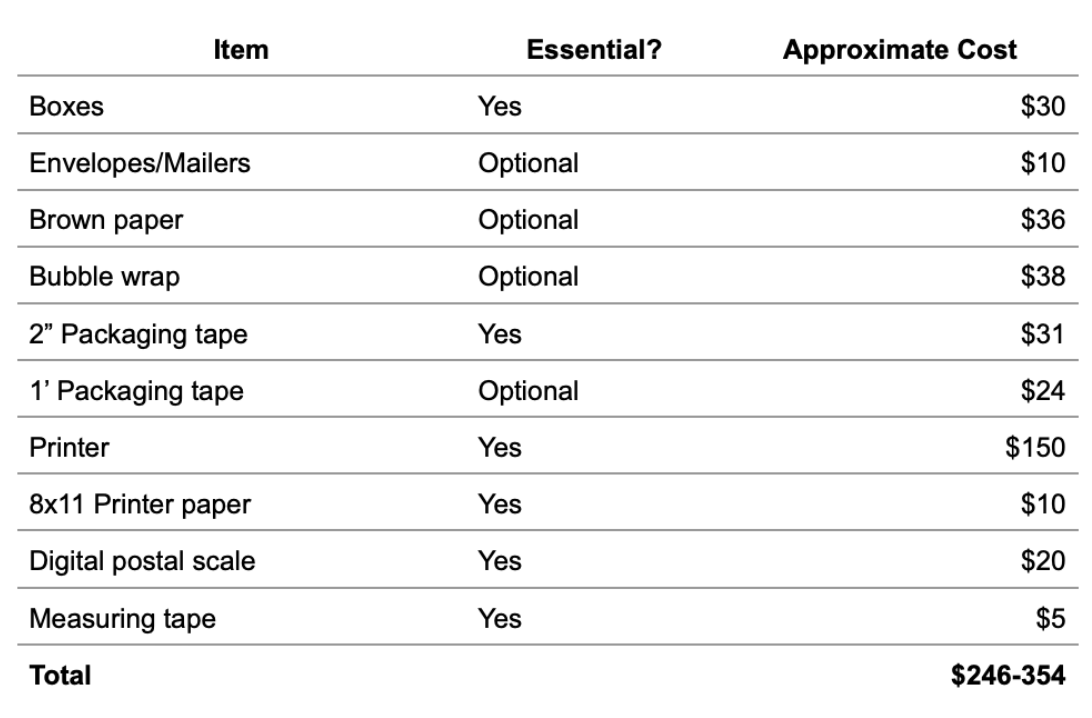
Estimated costs to start a reselling business
Hidden Costs
There are also some hidden costs of reselling that many people overlook when getting started in reselling.
Gas - frequent trips to the post office
Sales tax
Printer ink
Storage bins
Shelving
eBay fees
How you store your items and how much you ultimately spend on storage supplies and systems is depends on your personal preferences and living space. I personally have taken an approach of working with the space I already have, rather than buying a new shelving unit or other storage system. I wrote a post about how I store inventory. [link] I haven’t spent a penny on storage. But you may have room for a large shelving unit or stack of storage bins. If that’s the case, just be sure to take the potential costs into account. And you can always grow into that later as well.
Things I would not buy yet
expensive shelving
thermal label printer
custom thank-you cards
branded tape
logo stickers
inventory software
expensive photography equipment
All of these items are fun, and you may want to purchase them down the road. But my strong recommendation is to get at least a few months of selling under your belt to see if you like it and if it’s something you will stick with before investing in any of these items.
Final thoughts
If I could give every new reseller one piece of advice, it would be this: don't spend your first month buying supplies. Spend it learning. A roll of tape, a scale, and a few boxes are enough to get started. Your business will tell you what to buy next.
One of the advantages of starting in a small home is that you're naturally encouraged to be selective. Every item you bring home should earn its place. Starting small helped me focus on learning the business instead of accumulating inventory.