
My First 10 Sales: What I Learned (and What I’d Do Differently)
Your first ten sales … that’s a huge milestone. By the time you’ve made ten sales, you’ll have learned a lot and gained some confidence, too. Think about it - that’s ten items you have selected, photographed, priced, listed, and shipped. You’ll have made a lot of decisions and judgement calls along the way. And you likely will have answered a question or two from customers. You’ll have made some mistakes and found solutions to problems. You will be amazed that you actually made some money at reselling. And, importantly, you will realize that success comes not from perfection, but from building good systems.
In this post I will map out some lessons I learned from my first sale to my tenth.
Before You Make Your First Sale
Listing your first few items can feel like taking a leap of faith. You’ll wonder:
Did I price items correctly?
Why hasn't anyone bought anything?
Are my listings good enough?
Am I even doing this right?
Rest assured that everyone starts out with those same doubts! When I was getting started, I checked out blogs and videos made by experienced resellers to learn the basics of listing. That gave me a bit of confidence that at least my listings were decent. The quality of your listings really does matter - from having high quality photos to good descriptions and appropriate pricing - so I strongly recommend taking some time to learn about what makes for a good listing. There is a ton of good content out there.
Sale #1: The Excitement
I will never forget my first sale. The feeling of surprise when I saw the notification on my phone. The sense of gratitude that someone actually wanted something I had listed. And the almost disbelief that someone was willing to pay real money for something of mine.
I got lucky, because I made my first sale within just a few days, and it was for a pretty high dollar amount. I had listed a set of equipment for a specific home workout program. I had bought it and used it only once (a recurring habit I’m not proud of). I listed and sold it for $155. I was positively giddy.
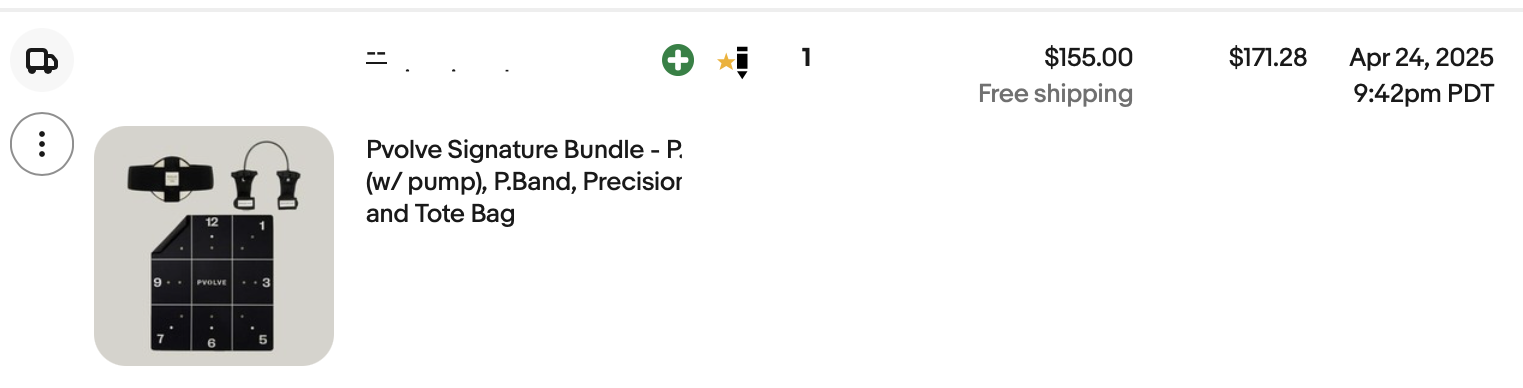
My first sale on Ebay was a set of workout equipment.
But then the reality of fulfilling the order set in. I had sold this item for $155, yes. But I had chosen to offer free shipping because I didn’t really feel confident in my pricing. So now I had to figure out how much this thing would cost to ship, and what kind of a box to use. It was fairly big and kind of heavy.
Surprises and Lessons
Shipping: It can feel stressful to find the right container to ship your package in if you don’t have your inventory of boxes built up yet. Fortunately I had set aside a box that was just the right size at the time of listing - I often do that when I list a larger item. But I hadn’t used the measurements and actual weight to figure out the shipping cost ahead of time. In the end, shipping cost about $13 - not too bad.
Transaction costs: These are the fees Ebay charges you to sell your item on their platform. The transaction fees for my $155 sale were $23.69! That just felt rude.
How much I really made: After all fees, the amount I really made on my first sale was $118.73. Not terrible, but definitely a reality check.
Stephanie’s Advice
Ebay charges different fees for different categories of item, but I have found from experience that assuming 17% is a safe bet for most items. Using one number is a part of my pricing system and keeps things simple.
Sales #2–3: Building Confidence
I made my second sale 11 days later. Those 11 days felt like an eternity. That’s when I started to doubt myself … had I chosen the wrong items? It’s funny to look back now on the anxiety I felt then. Having an item sell within 11 days is actually pretty great. Most items take much longer than that to sell. My third sale happened a day later. But all I remember now are the feelings of doubt and disappointment that things weren’t happening faster.
Sales two and three were not as lucrative as the first. I sold a women’s workout clothing set for $26.99 ($14.07 profit) - not too shabby. But my third sale served as a major lesson - and unfortunately, one that I would have to learn more than once. I sold a women’s raincoat for $35. I had paid $20 for it at Goodwill, though, and in the end my profit was negative $1.22. Oh no!
I had ventured out to Goodwill and bought some items to sell, including that raincoat. Understanding how much you can afford to pay for an item based on how much you can sell it for is critical. But I had not developed that understanding yet. My thought process went something like, “This is a cute raincoat that I would wear! It’s an expensive brand. $20 seems like a good price!” A lot of resellers make this same mistake in the beginning. That’s why it’s a good idea to go slow when it comes to purchasing inventory.
Surprises and Lessons
Estimate your profit before buying: You always want to get a sense of how much something will sell for before you buy it. Now I look the item up on Ebay while I’m at the store, estate sale, or wherever. Then I do a quick calculation in my head: I assume 17% fees charged by Ebay and subtract that, plus my purchase price, from the amount I can likely sell for. That arms me with the information I need to know whether an item is worth buying or not. Advice
Packing gets easier: Packing and shipping items began to feel less scary after the third order. When I realized no one was reaching out to complain about my packaging jobs, I let out a sigh of relief. By this point you’ll be starting to get a sense of what items need to go in a box and which can go in a poly mailer, how to safely pack items, and what shipping materials you need to have on hand.
Listing becomes less intimidating: By the time you’ve made your third sale, you’ll have listed quite a few more items. You’ll have looked at other people’s listings and used them as examples for your own. One thing I always do is look at sold listings in addition to current ones, since those were ultimately successful in getting someone to buy.
Sales #4–6: Finding Your Rhythm and Establishing Systems
After you have your first few sales under your belt, you’ll be thinking, “Hey, I am actually doing this!” You’ll feel more confident in your ability to take photos, develop listings, and ship items. But you’ll also have realized that reselling is real work that can be very time consuming. Efficiency is key to keeping your momentum, so now will be the time to turn your attention toward developing systems that will save you time and make things easier in the long run.
Shipping supplies
For your first few shipments, you can get away with using the scissors you keep in your kitchen drawer, a box stored in a closet, and a tape measure that you had to take time to locate somewhere in the depths of your home. But that type of fly-by-the-seat-of-your-pants operation will get old quickly. You will definitely need to set up a shipping station.
You will want to find a spot in your home that can serve as your shipping station. You may not have an immediately obvious space - we live in small homes after all, and so have to get creative. You may have space for a station at the corner of your kitchen counter or for a small table in your living room or in a hallway.
I run my Ebay business out of my bedroom and use my desk as my shipping station - with tape, scissors, tape measure, digital scale, and packing materials all stored in drawers. And my printer is right there as well. I store boxes under my bed and packing materials like bubble wrap in a large suitcase in my closet. Basically everything is within a few steps of everything else. I also force myself to put everything back in its place when I’m done so that I can grab it easily the next time it’s needed. Organization is key, especially when you live in a small space!
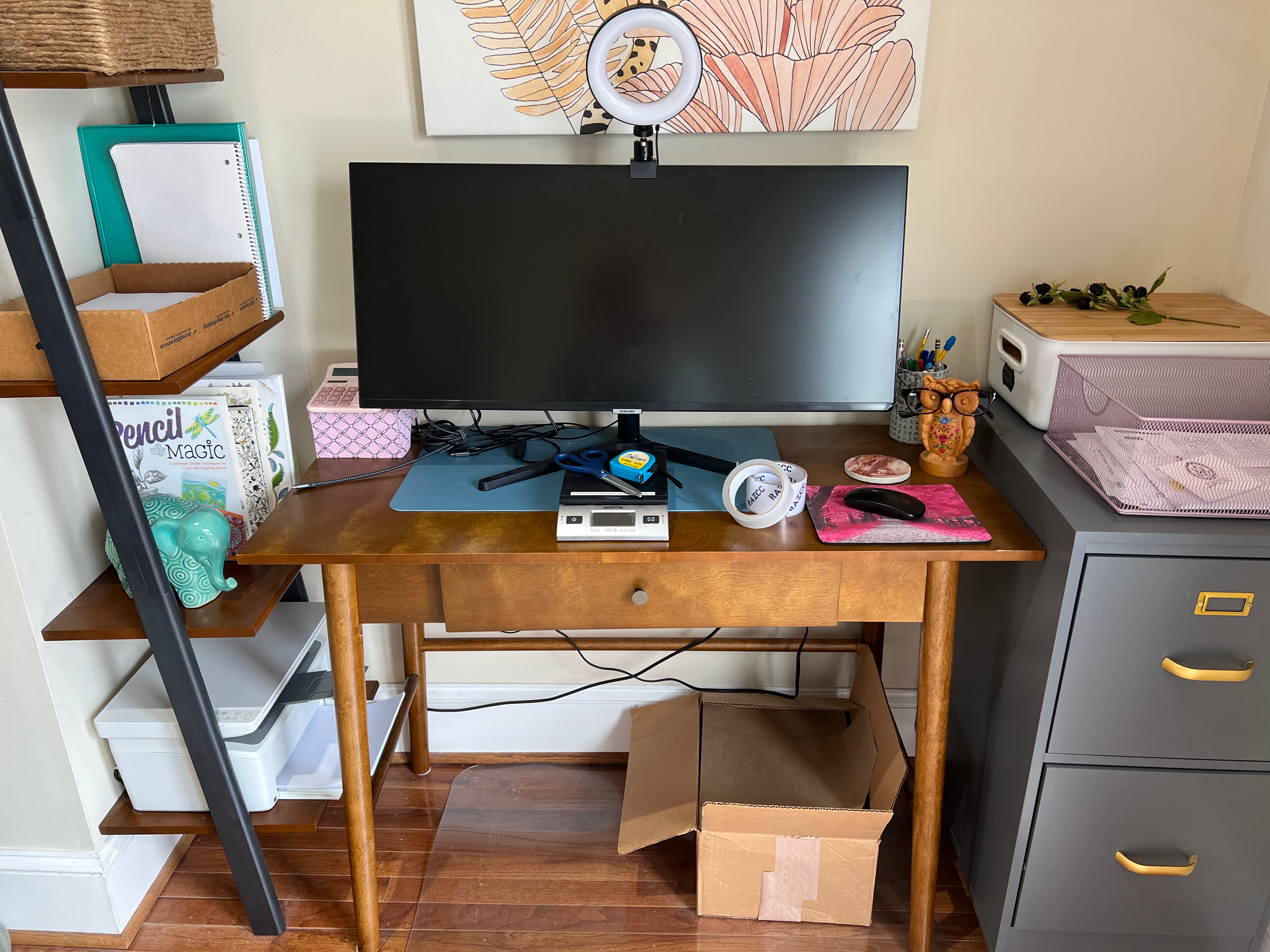
My shipping station - tape, scissors, and measuring tape are stored in drawers and a box of brown packing paper is stashed underneath.
You can learn more about how I store shipping supplies here.
Storing Inventory
When you only have 5-10 items in your inventory, you can keep mental tabs on where they are, even if they’re scattered throughout your home. But once your inventory starts to grow, you’ll need designated space(s) for storage and a system for keeping track of where everything is stored. It’s best to start thinking about that early because things can get out of control really fast.
Space: If you happen to have a spare bedroom or large closet in your small home, count yourself lucky! But most of us small space dwellers have to get creative when finding places to store things. You have to look for extra bits of space wherever you can find them - maybe a shelf in a closet, a corner of a room, or under your bed.
I wrote a whole post on where I store my inventory. You can read it here.
Keeping track: You’ll also need a system to keep track of where each item is stored for easy retrieval. It doesn’t have to be complex, though. My inventory tracking system is very simple and ad hoc - I keep a spreadsheet with the location of each item, and just list the location as a description: bedroom closet top shelf, linen closet, green plastic tub, etc. It’s not perfect, but it works for me and allows for the addition of new spaces as my business grows. You will want to come up with a system that works for your and your home.
Sales #7–10: Learning What Works and What Doesn’t
Now you’ve got some momentum going. Hopefully you’re having some fun, too! Looking back on my first ten sales, I am remember that each sale felt like an ah-ha moment because I was gaining insight into what sells.
Surprises and Lessons
Which categories sell fastest: One of the most important lessons every new Ebay reseller learns is that the items you are excited to list are not necessarily the ones that sell. I am obsessed with everything from the 80s (the best decade), and one of the first items I listed was a vintage 80s Liz Claiborne mini skirt. It was so cute! I definitely would have kept it for myself if only it was my size. But it sat in my Ebay store for 8 months and maybe 1-2 people even viewed it. At the same time, I listed a matching bike shorts and sports bra workout set, which I personally would never have worn (because we had a very different relationship with spandex in the 80s). It sold within two weeks. That’s when I realized I had to be thoughtful about listing things other people actually want to buy.
Which photos work best: If you look at other people’s listings on Ebay, you’ll see a wide range of types of photographs. Some look professional and some look well … pretty bad. Because I had no experience with product photography, I started out by watching several tutorials (I found this one by Krause Media to be particularly helpful), and I would suggest you do the same. The most important things I learned are:
A plain, light colored background is best
Lighting is important
Take photos of each item from every possible angle.
I also learned that you don’t need to buy special photography lights (although they are nice to have and I eventually bought one after about eight months). There’s a lot you can do with natural light and a floor or task lamp. You’ll learn a lot through trial and error. But do find a designated space in your home where you will take photos so that you don’t have to set up from scratch every time. My photography station is set up on top of a hamper set against a plain wall, and it works great!
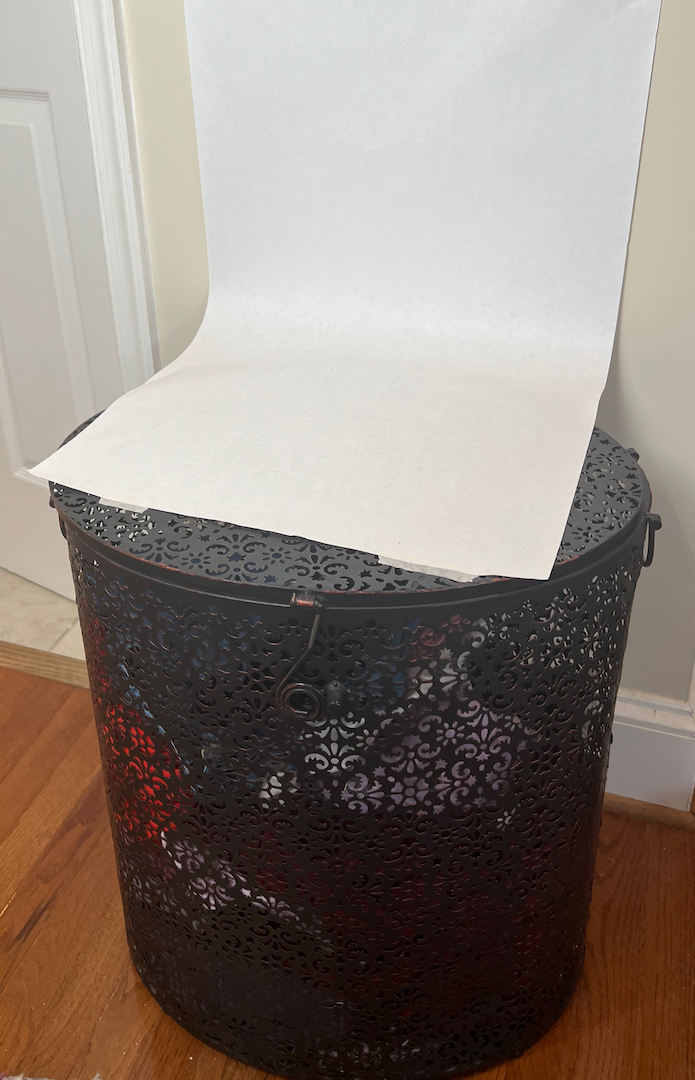
Photography Station
For my photography station I use a large sheet of white paper taped to a hamper set against a wall. It’s simple and space saving!
Final thoughts
Hitting your tenth sale is a major milestone. At the time, I didn’t think to stop and celebrate it. But looking back, I wish I had. Because I had gone from nothing to having an actual business, and that is worth celebrating.
After your tenth sale you probably won’t have made much money. The reality is that making money reselling on Ebay takes time and a lot of work. This isn’t something to get into if you are looking to replace income from your full time job, especially if you live in a small home where storage space is limited. It is a lot of fun, though, and a great way to supplement your income.
My suggestion is this: Don’t measure your success by how much money you’ve made after your first ten sales. Instead, measure by how much you’ve learned. By your tenth sale, you'll know more about pricing, photography, customer service, and shipping than you did when you started, and that's the real foundation of a successful business.