
Organize Your Home by Functions, Not Rooms
Operating a resale business out of my small home taught me something important … the secret to making it work isn’t having more space; it’s asking more of the space you already have.
When I moved into my 1,300 sq ft condo after my divorce three years ago, I was downsizing from a 3,500 sq ft house, where I had had a spare bedroom and a two-car garage that was used exclusively for storage. I worried about how I would find space for all of my stuff. I have two young kids, and we all know that kids come with a lot of stuff.
For the first two years, I struggled to keep a handle on all of the stuff in our small home. I was constantly digging my way out of a sea of toys and art supplies in the living room, pet supplies and papers in the kitchen, and unfolded laundry pretty much everywhere. No sooner would I have my home tidied up than I’d look around and find it was a disaster zone again. I read what felt like a million blog posts on organizing a shared kids’ room, toys and art supplies, and none of them really worked for me. Then I realized all the writers lived in larger homes. I didn’t have an extra room that could be set up as a play room, or space in the kitchen for an art table, as so many bloggers suggested. I had to find a system that worked for my family and my home.
My “Ah Ha” Moment
One day while feeling particularly overwhelmed, I was struck by the realization that I needed to actually find space for all of the things that were constantly getting in the way. As an example, my kids like to work on art projects in the living room. No matter how many times I carried their art supplies back to their bedroom, they kept wandering back out to the living room. The floor and coffee table were constantly littered with markers, paper, pom poms, pipe cleaners, etc. I had this “ah ha” moment: I was fighting the flow of daily life in our home. “Why not just dedicate space in the living room to art supplies?” I thought. So I bought some bins, and now the art supplies live in the entertainment center. Cleaning them up takes about 2 minutes.
After that small success, I started to look at my home differently. I went through my entire condo room-by-room and viewed each space through the lens of function.
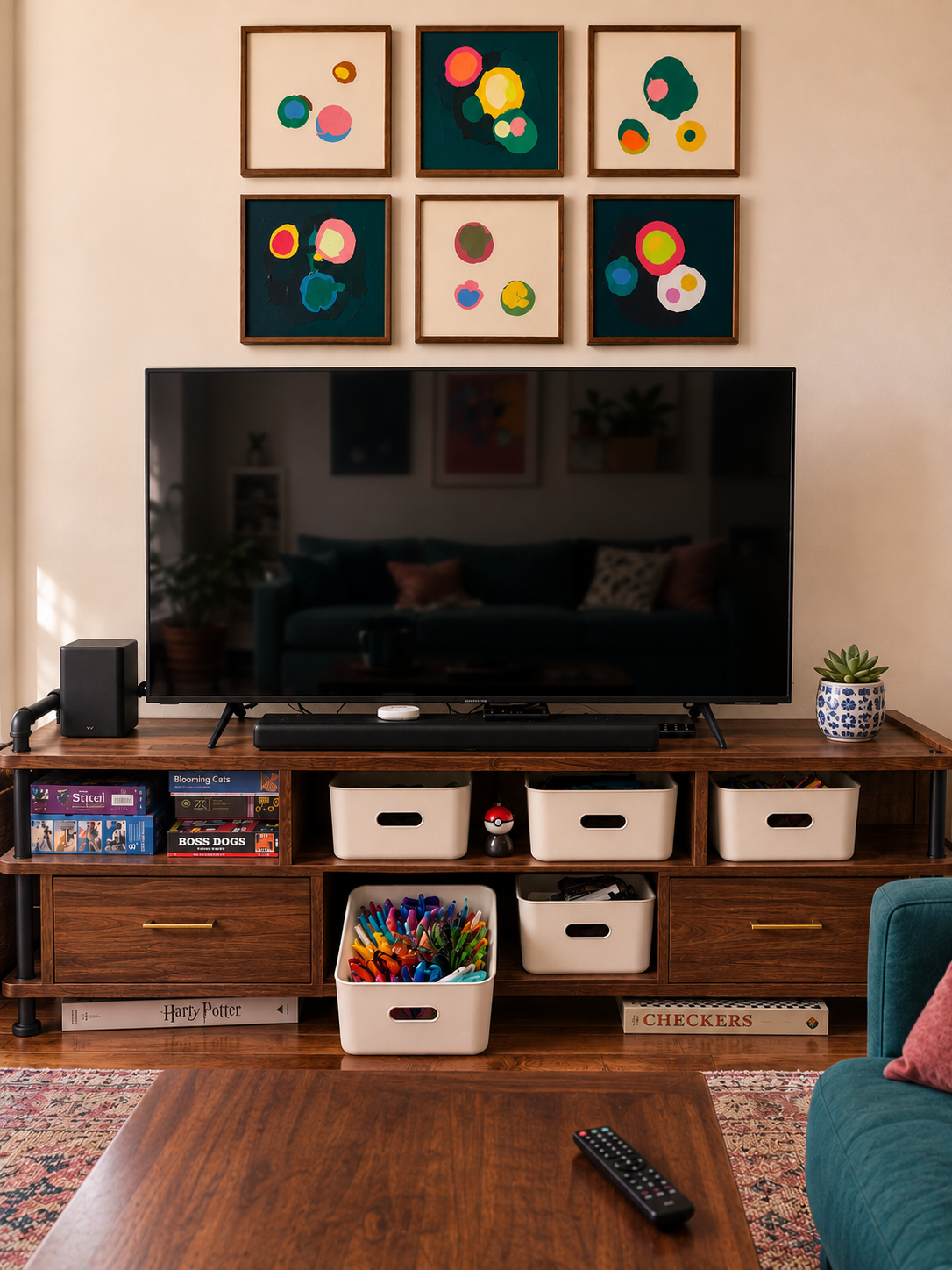
I made room for my kids’ art supplies in the living room.
I discovered a really useful thing along the way that eventually became the basis for being able to operate a reselling business out of my home …
The secret to being able to live comfortably in a small home isn’t necessarily having less stuff (although that certainly helps). It’s shifting your mindset to organize every space by function.
What exactly does it mean to organize by function? Let me explain.
Large Homes vs Small Homes
In a larger home, it’s typical for each room or space to have a unique function. The kitchen is for cooking, the dining room is for eating, the bedrooms are for sleeping, the basement is for storage, and so on. But in a small home, there just aren’t enough spaces to live that way. One space might have three or four different jobs. The living room might serve for tv watching, craft making, and entertaining. The kitchen might serve for cooking, eating, and doing homework. And your bedroom might double as a home office and place for storing reselling inventory!
If you don’t plan around the multiple purposes that each room in your home serves, your space can quickly become cluttered and overwhelming.
Think of Functions, Not Rooms
Instead of asking, “what room is this?” ask “what functions happen here?”.
One corner might be used for:
Storing inventory
Charging electronics
Hiding a printer
Storing shipping supplies
That one corner has four different jobs!
Every Cubic Foot Counts
This is one thing that really sets life in a small home apart from life in a larger home. When you don’t have as much square footage, you have to take advantage of your cubic footage. That is, take advantage of vertical space as well as horizontal space. Think about storing things in closets, on shelves, under the bed, and behind doors.
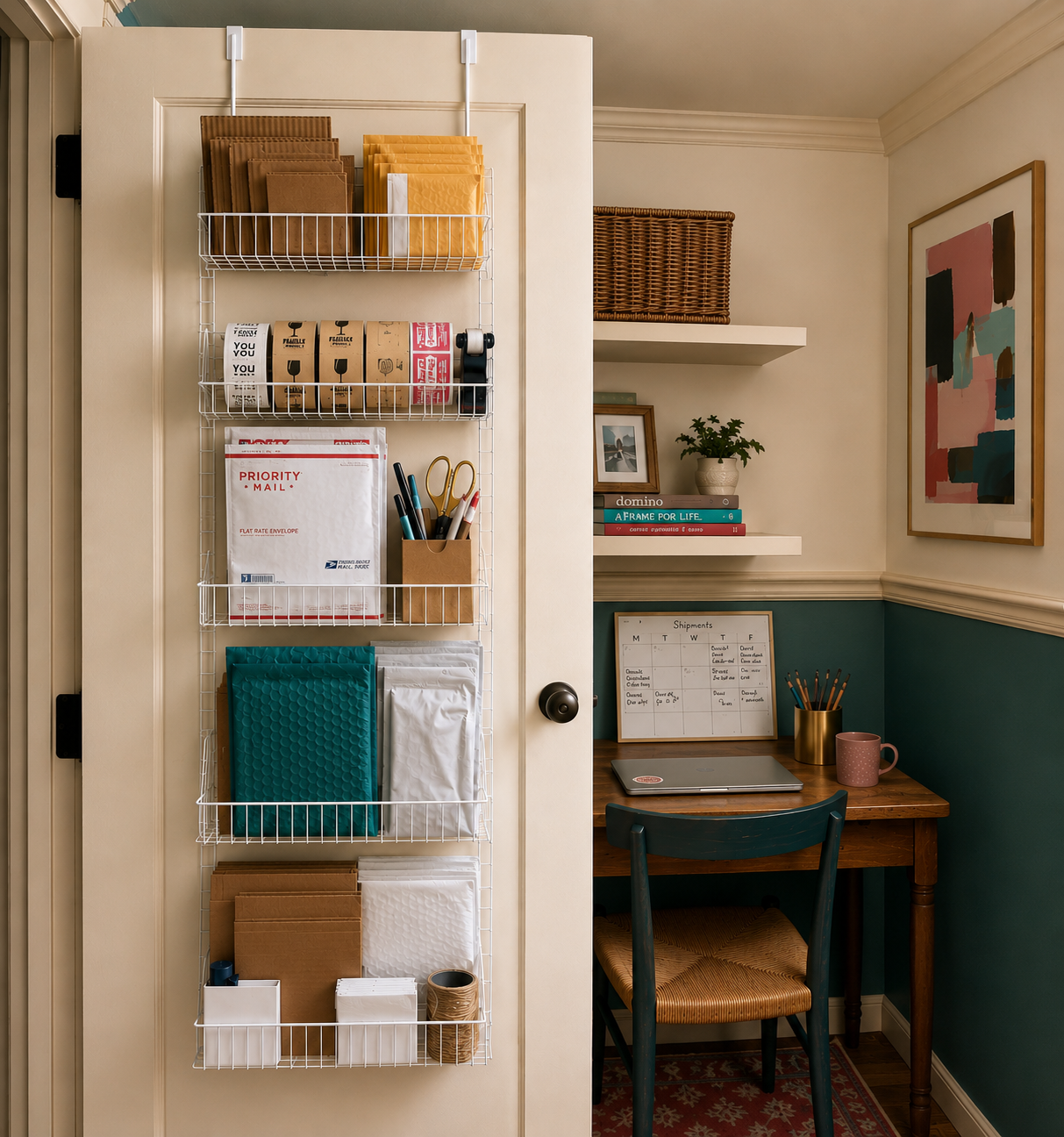
A closet door can make for valuable storage space in a small home!
Assign Every Storage Area Multiple Jobs
Small homes never seem to have as many storage areas as we’d like, but you can take advantage of the ones you do have by making them multi-purpose. A hall closet isn’t just for coats; it might also be used to store your vacuum, holiday decorations, off-season clothes … and now, your shipping supplies.
My linen closet stores linens, extra toiletries, cleaning supplies, paper products, pet supplies, and some Ebay inventory. I keep this system manageable by designating a space within the closet for each category. I take advantage of the shelves and have a designated bin for each item type.
The Power of Zones
Another helpful way to think about this is to think of each room in terms of zones. A single room can have a zone for each function.
For example, because I run my reselling business out of my bedroom, I have established the following zones:
A sleeping zone
A reading zone
A laundry folding zone
A shipping zone
A photography zone
A listing zone
Multiple storage zones
This may sound chaotic, but it works for me.
Stephanie’s Advice
Give yourself permission to organize your home in the way that best works with your day-to-day life. You don't have to organize to other people’s advice or expectations!
Try This Exercise
Here’s a helpful exercise to undertake. Go through your home space-by-space - every room, closet, and even the hallways. Take a notebook with you and write down all of the things that happen in each space. Then sketch out each space on its own page and draw in the zones that you will set up. This exercise will force you to be clear eyed about the ways in which you are already using your spaces, help you uncover why certain areas always feel so unmanageable, and spur creativity in how you set them up to function more smoothly.
I recently did this with my bedroom closet. I have a pretty large walk-in closet that is always overflowing and chaotic. A few weeks ago I decided to undertake this exercise to identify where the problem stemmed from. I started by listing all of the categories of things that I store in the closet:
Clothes
Shoes
Purses
Backpacks and tote bags
Suitcases
Jewelry, sunglasses and belts
Out-of-season clothes
Dirty laundry in hampers
Large boxes for shipping
Packing materials (kept in a suitcase)
Some Ebay inventory (on shelves)
Emergency supplies (extra food and a water purifier)
Items set aside for donation
That’s a lot to ask of an 6.5 x 5.5 sq ft space!
Next I asked myself whether I had a designated space for each category of item. I did … sort of. So why was there so much stuff spread out on the floor, falling off shelves, and generally strewn about? Something was not working. I took a closer look and noticed that I needed to create more defined areas for each type of item. I was mixing the clothing inventory for my Ebay business with my off-season clothes and the bins were overflowing. I wasn’t breaking down boxes and was just leaving them on the floor. I was stuffing packing paper and bubble wrap anywhere it would fit. And my emergency food storage bin had become a catch all for lots of random stuff.
I see this as a perfect example of creating a multi-functional space in a small home. I don’t have a laundry room, pantry, den, or basement. I need to use my bedroom closet for all of these different things, and that’s okay.
I then sketched out zones for each type of item and put everything where it belongs. For now my closet is functioning beautifully. At some point in the future I’m sure it will become unruly again, at which point I’ll repeat this exercise.
Make Changes As You Go
The beauty of organizing the spaces in your home by function is not only that your home will run more smoothly, but that you can make changes over time. As my business grows, I am slowly dedicating more and more space to storing inventory. I can do that comfortably because I use this system of carving out little spaces wherever I can find them.
Likewise, a day will come when my kids aren’t doing art projects in the living room anymore, and then I’ll be able to dedicate that space in my entertainment center to something else. Taking a fresh look at each space in your home periodically allows you to stay flexible in how you use them.
Staying Organized Gets Easier
When every area of your home has a defined purpose, and every type of item a designated space, clutter decreases and putting things away (and finding them later) becomes easier. I am definitely not a naturally tidy or organized person, but this system works for me and has allowed me to make room for a reselling business in my two-bedroom condo.
Final Thoughts
Small homes don’t force us to live with less stuff; they teach us to live more intentionally. Living in a small home might drive you to examine the things you do have and make decisions about what you really need or want to make space for, and that’s a good thing. But when set up to accommodate your day-to-day life, you’ll find that your small home actually has plenty of space!